Saturday, November 15, 2003

Livin’ Large Between The Matrix & Stagecoach


“I’ll meet ya’ at Borrego Springs…Partner!” he said with a drawl so deep that the end of the sentence arrived with the beginning. Then he turned around and walked through the wall, carefully stepping over road apples and the fireplace before fading into the distance, with his horse.

Being shaken awake by the ghost of Robert Mitchum was a small price to pay for a full day of canyon carving, testing, moto-modeling and indulging in general hooliganism on the ’04 Yamaha YZF-R1. Add to that; hanging with Jamie James, Doug Polen, the guys from the Internet R1 Forum plus the Yamaha crew, and it could have been the spirit of Zorro or the Federales armed with their badges for all I stinking cared! The unbridled pleasure of riding the bigger better smoother faster version of the already flawless R1 (not to mention being passed on the inside by Doug Polen, in the fog, with him moving so fast that my paint wrinkled!) was an experience worth far more than a full night’s sleep.

Days earlier and diagonally across the continent, I was lamenting the grayish, aging snow that was residing on the roofs of Nyack. This winter brought waves of it with too few days of respite above the melting point. Slice into any snow bank and you could read the winter’s history, each thaw creating a crispy layer just in time for the next storm. I haven’t enjoyed a clear path from my garage to the street since Thanksgiving. Not exactly the harbinger of riding weather.

I’d finally surrendered, admitting that the damn groundhog was right when the rescue call came from Yamaha. Before you could say “El-Kabong!” my lizard-skin boots and I were at the Hertz counter in San Diego pointing at the red Mustang convertible.

Flying to San Diego was a cakewalk compared to the ninety miles of traffic and intermittent torrential rain that I coerced that car through. Why do all Californian drivers turn into studio starlets in the rain? While the wind whipped the convertible’s top until it quivered like a surplus Boy Scout tent I coaxed the car up the mountain eventually leaving the freeway as the weather eased. We drove by outer-world landscapes, mounds of large white boulders abandoned millennia ago by heaving movements in the earth’s crust were framed by charred remnants of groves and estates lost in the recent fires. The rains came too late. I cautiously drove through the haunting mountain pass and deep into the Borrego Valley. My destination was the desert oasis of La Casa Del Zorro.

As what little light there was faded, I found myself pondering the irony of circumstance; I was driving on road that began as an emigrants trail where thousands died leading their families, livestock and all possessions to a better life. “But is it?” I asked myself, while enjoying a car named after a horse, whose vitals are controlled by computers, searching the spectrum of Satellite radio, on a mission taking me to ride the latest in high tech motorcycles. Measured against the bizarre landscape I felt suspended in a strange dimension between the “The Matrix and Stagecoach”. Then I found the adult comedy station and all was well.

Borrego Springs sits high in a desert mountain pass smack in the middle of the Anza-Borrego Desert State Park. One of the largest parks in the west boasting 600,000 acres of canyons, badlands and sand dunes yet only five or six actual paved roads. As opposed to La Casa Del Zorro, which is an oasis centered on that said plain with all the 21st Century amenities you and I would want and those early settlers couldn’t imagine.

My poltergeist left behind a damp gray morning but La Casa Del Zorro’s hot breakfast and Yamaha’s fast company, which included the aforementioned hooligans and “Ileen the Umbrella Girl” more than made up for some lost sleep.

I picked a red rocket to match my leathers and was shortly warming my tires with some fellow riders behind Photographer Tom Rile’s rental car. The masters of weather and light favored us for the photo session and then it was off on a mission to terrorize the twisties in time to meet the others for lunch at a place called Mother’s.

Back in 1998 Yamaha set the sport-bike world on its ear with the trend-setting YZF-R1, and for 2004 they’ve set the R1’s engine on its proverbial ear, allowing the frame to go above the heads as opposed to around them, giving the rider two more inches and no, its not the two inches that your daily dose of spam promises.

With Spam as the furthest thing from my mind I rode the bike into Mothers’ lot in line with her sisters. It had been a few hours of Alpine-style riding, both in texture and temperature and I was ready to sit by a warm fire. The row of Ones and boisterous banter emanating from inside the restaurant indicated that we’d wandered up the correct pass. Mothers’ chef did a very Californian-style vege-burger with beans and cheese and for once I remembered to ask ‘le Chef’ to nix the Thousand Island dressing.

What is it with these California and Thousand Island dressing on burgers? I’ve heard rumor that in the 1950s there was a statewide ketchup shortage. Politicians urged drive-in and luncheonette owners to come up with a new burger-friendly condiment because too many out of work carhops and soda jerks would cause collapse of the entire southwest economy. Meanwhile the Mexicans refused to sell the gringos the secret of salsa, which actually tasted good on burgers. Things looked bleak until a blonde carhop, fond of Thousand Island on her salad decided to add the salad to the top of her burger in order to save time eating and the rest is history.

East coast burger fans traveling west be warned that now, with Arnold and Maria, who are as mayonnaise a couple as you could get, posing as California’s First Family there’s no hope for a burger without that poisonous pink spread. Unless you demand it, loudly!

Prior to lunch I had the chance to grab an ’03 One for a few kilometers and instantly noticed the difference. Comfort zone is first to mind; bars are higher by 10mm, pegs lower by 7.5mm and a bit more forward 2.5mm, not large numbers but the proof is in the riding.

According to Yamaha’s media materials, the frame’s redesign increased its rigidity by 200% vertically and 50% sideways. I’ve learned a wee bit about motorcycle riders and motorcycle physics on this job and can’t envision any situation where a 200% increase in rigidity would be unwelcome. Cheers to Yamaha.

The stiffer chassis plus a front geometry change of increased rake and offset increased the One’s flick-ability tremendously but it’s the throttle response where I found nirvana. The One has a new fuel injection system that uses a motor-driven secondary valve controlled by a new 32-bit computer system. This puppy hums and rolls smooth from stop to the 13,750rpm redline! My vote for best improvement is for the computer and new throttle bodies but the lighter crankshaft and pistons deserve a bit of the credit.

Yamaha’s also hot on their new Fracture Split con-rod caps, which provide a more precise fit over the bearings. Cracking the bottom of the connecting rod provides a rough surface like the nooks ‘n crannies on a fork-split muffin, creating two halves that mate perfectly with increased rigidity. Need I repeat my philosophy of rigidity?

The engineers are also proud of the new sleeveless cylinder design, which allowed the cylinders to operate in closer quarters and shaves nearly an inch from the camshaft. All of these improvements are crammed into a crankcase 56mm smaller than last year’s.

While all the above creates the smoothest power-plant this side of the Grand-Prix circuit, the power needs to reach the wheel and the One does it with a new transmission that is the the smoothest shifting gearbox mechanically possible.

When you’ve would her up to the redline and see the bubble gum machine cresting the horizon you’ll scrape the speed off quicker than ever by pumping Dot 4 from the larger (14mm to 16mm diameter) Brembo radial master cylinder into redesigned calipers that grab a 22mm larger 320mm rotor who’s also dieted off a half mm in thickness during the last model year.

I spent the better part of the daylight hours riding the desert plains and passes, much less time in the saddle than it would take to list the 400+ improvements; LED tail-light, titanium exhaust, 5-spoke wheels, 43mm Kayaba inverted forks, stiffer triple clamps, Die-cast swing-arm and sub-frame to name a few. I was reluctant to return the One to La Casa Del Zorro were it not for the rain growing to a steady downpour.

After leaving the Mustang at Hertz’s stables I got on the line for the stage to the airport. “What magazine you write for?” came a voice from behind. Betrayed by my leathers, I turned to meet a fellow rider. Vacationing from Atlanta he told me that he was taking delivery of his new R1 as soon as he got home.

I said that I’d meet him at Borrego Springs.

Monday, January 06, 2003

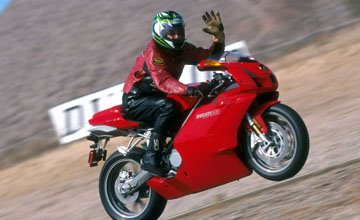
Riding the Ducati 999 - January 2003


“What’s in a nose?” Don Miguel de Cervantes, 1559 (est.)

Since the first spy photos of the “Red-volutionary Ducati 999 were posted on the web, Ducatisti worldwide have been exhibiting symptoms of acute schnozophobia. If you have friends fond of Italian sportbikes, keep an eye on them for signs of this disease, which manifest incredibly fast.

Victims are usually male (but there is an increasing number of females reporting symptoms), in their late 30s to mid 60s and may own any type of motorcycle or possibly none at all. The first symptom is an uncontrollable compulsion to talk about Ducati motorcycles, which continues despite constant efforts by friends and family members to subdue them. Without intervention, the disease mounts a final assault which results in a large dent in their checkbook, or a series of small dents each month for a few years. However, there is a study currently under way that has uncovered information which leads researchers to believe many of these “schnozophobic Ducatisti” enjoy lower blood pressure, less heart disease, are able to metabolize stress and watch much less television; but these research results are currently inconclusive.

I’m sorry to report that Sean Marcus, the progenitor of the Marcus Dairy, has recently been infected. I had only been back in town for a few hours when Sean called.

“Hey guy,” I apologized, “I just flew in from the coast and haven’t settled in. Can I call you tomorrow?”

“What were you doing in California?”

“Riding the 999.”

Silence.


“You rode the 999!”, he said, then there was a short sentence, mumbled in jest, that referred to my heritage, good fortune, and the specific state of my parents nuptials at the time of my birth.
After which he asked, “Is that nose as ugly in person as it looks in the magazines?”

While not a professional proboscanist, my knowledge of noses is nothing to sneeze at. (Perhaps you should have read that sentence with a cigar and a painted-on mustache?) It’s a cultural thing, I grew up Jewish in New York City, and I have serious hay fever.

I assured Sean that the 999 is much more than a 998 with a rhinoplasty. After which I was launched into a long discussion weighing the pros and cons of buying a new 999 vs. an ‘02 Duc which carries two year’s free maintenance.

The Doctor is in, and the prognosis is that if you want one of these puppies, you’d better haul your Dainese-clad ass over to the nearest Duc farm.

Most annoying about this spate of schnoz-ophobia is that it’s directed toward an Italian product. I’ve got to laugh because when it comes to style, the Italians have it dripping from their noses, so to speak. So for myself, I defer to Bologna in most matters of design, especially with anything that’s painted red.

Willow Springs was a short ride from the motel in Lancaster. It was early winter on the high desert and the sunlight filtered through the haze just above the horizon, promising a dry, clear day. My nose thanked me. I parked my rental and noticed a dozen new Ducs lined up like dominoes so the desert light could cascade down the row, caressing each one. I stood still for a moment to soak up the scene. The best days start at the track, and they’re better when you’re on someone else’s bike.

“Damn, you are one lucky bastard,” I said to myself, having no clue that Sean Marcus would mumble the same words a week later.

I signed away any right to hold anyone but myself responsible for whatever may happen on the track (print here, then sign here. Have we done this enough times?), then I joined the Ducati folks for a rider’s meeting and a briefing on the bike, after which other journalists threw even more jabs at the Italian Superbike’s proboscis.

Ducati dubbed the 999 the “REDVOLUTION”, since the bike is more than the technological evolution of the 851 – 888 – 916 – 996 and 998 bikes that ran before it, and red being the color of Italian racing. (I guess it’s a good thing that Rudolph isn’t an Italian name. Care to join me in a chorus of “Rudolph the red-nosed race-bike”?)

Witty marketing dialogue aside, the bike IS revolutionary, from the re-designed bodywork to the wiring harness to the asymmetrical exhaust and adjustable ergonomics. The only Ducati attributes that remained untouched are the trellis frame, L-twin engine and desmodromic valve actuation.

I found my earplugs in the third pocket I looked in (out of four), screwed them into my cranium, then donned my helmet and tugged the strap snug. Raising my visor, I surveyed the situation. Twelve Ducati 999s, a few 998s, the fastest track in the west, and a dozen testosterone-charged moto-journalists, each on someone else’s expense account; truly, the ultimate expression of “Riding Free”.

I picked out a bike, threw a leg over it and listened as everyone else’s muffled exhaust notes roll by until I was alone in the pits. Quarter-turn of the key, some lights flashed and the tach needle took a bite out of the redline, then dropped, dead. I pressed the start button and it wouldn’t. I reset the key. You see, the computer cuts the ignition circuit out after 15 seconds, then you have to reset it by turning the bike off and on again. Which I did, then I pressed the little button with my right thumb, again nothing. An Italian tech ran over to me and yelled something that I couldn’t hear or heard but couldn’t understand. I pointed to my ear and shook my head. He pointed to the ground and shook his head. I looked down and learned that I failed to raise the sidestand.

“OK”, I mumbled in my helmet, “an ignition cut-off.”

This time the little button on the right grip launched the Testastretta into its distinct idling shiver. With the engine running, I placed both my boots flat on the pavement and felt the resonance of power strokes radiate from the bike. I rocked the bike between my thighs. The bike is thinner and lighter than last year’s model; too bad I’m not.

I eased out the clutch and rolled toward the track, dropped my faceshield down and it answered with a solid click, a quick peek over the shoulder to confirm all clear.

I’d like to welcome you to this little Willow Springs Motorsports Park, dubbed the “fastest track in the west” and if you’ll just ride along, I’ll mention points of interest, the first of which is known as Turn One.
Also known as Castrol Corner, Turn One is a 90-degree left-hander that looks like a dead end when you’re on the final straight, tucked in and WFO. Assuming you’ve grabbed the binders in time, you’re now rolling on and sliding your butt off the right for Turn Two, a 450 foot radius sweeper that gnaws at the foothills, also known to the locals as the Rabbit’s Ear. Turn Three is the bottom of the bunny’s ear.

Budweiser Balcony skirts the Rabbit’s nose. Turn Five lets you scratch him under the chin. Turns Six and Seven are mere wiggles along the bunny’s belly. But beware of Turns Eight and Nine. Eight rolls along the rabbit’s rump in the form of a 900 foot radius sweeper that cascades into Nine, a 600 foot radius sweeper. Coming around Nine on the outside sets you up for the full-throttle half-mile straight, until the dead-end illusion of Turn One re-appears.

Crossing the start-finish line I tapped the starter button, which really wasn’t what I really wanted to be thinking about while rocketing WFO down a 2400 foot straight, but those stylish Italians hid the wiring for the lap timer in that same button and I came to play with all the toys, so I did it anyway. The on-board computer will remember the previous 19 laps, and they can be recalled on the instrument panel.

All afternoon, Lee Parks was trying to beat 1:30 and finally clocked a1:30:00 by the end of the session. Just thinking about pushing that button has got to cost at least .01 seconds. Regardless, having a built in lap timer is cool.

While we’re talking electronics, here’s the big news. Massive wiring harnesses are history! The 999 uses a CAN (Controlled Area Network) system. Simplified, it means that all the sensors send information along the same two leads and the CPU decodes them all. Fifteen specific streams of information traveling over two wires. Less spaghetti, less weight.

The 999 heralds the return of the double-sided swing-arm. Chosen for superior rigidity. The frame is 20mm smaller than the 998, but the hollow-cast swing-arm is 15mm longer. And for the first time on a Ducati, adjustable ergonomics. Fitting the bike to the individual rider’s size and comfort is accomplished with five-way adjustable footpegs and a seat/tank combination (on the monoposto version) that is adjustable fore and aft by 20mm. The footpegs offer 5-position adjustment, 2-up/down and 3 front/rear. The brake pedal moves 23 mm in slot and the fuel tank offers three positions front and rear, allowing a10mm adjustment.

Ducati tested with riders ranging from 1.6 meters to 1.95 meters to help determine the range of adjustment required to optimize the 999’s ergos.

The layout of the 999 loads the front end of the bike appropriately for optimum handling without putting excessive weight on the rider’s hands. The rear of the tank is rounded with a low and narrow area where the knees rest, making the bike feel extremely compact.
Low speed maneuvering was improved by increasing the steering angle to 28.5 degrees and the steering head was redesigned using computer stress analysis; the result looks cooler and is 10% stiffer.

Speed starts getting scrubbed off by the new Brembo radial master cylinder, only on Ducati, which was designed to make the system more compact – a smaller master cylinder allows for more rotation of the bars. Brembo also hid the bleeder screw within the reservoir, and the new brake lever is adjustable to an infinite number of positions.
The discs have an improved stiffness-to-weight ratio because they’re using 5 fasteners instead of 6, and the piston on the rear disc was enlarged from 32mm to 36mm.

We were informed that the asymmetrical exhaust was necessary to fit ANY exhaust system on the bike. The computer-designed solution has a large silencer that rests under the seat; well, actually bakes would be a better word. At the track, where more time is spent on your toes than on your ass, the heat isn’t a problem; just don’t get stuck in summer traffic with your significant other on the pillion.

While the twenty or so laps I managed to log with the start button barely scratches the surface of respectable testing, it doesn’t matter because they’re already dusting the shelves in Bologna to display the pending World Superbike trophies. But who expected any less.

Saturday, November 30, 2002

California Trip - December 2002

I just returned from ten days in California. Halfway into the trip, T Bear dropped me an e-mail that began, "Hey Caliboy, did ya dye yer hair blonde yet?"

The location was Willow Springs International Raceway. A dozen or so of us slightly weathered journalists had gathered to enjoy the clean air and warm sun of California's high desert and to spend some track time with Ducati's Redvolutionary 999: the slipperiest, slickest and speediest Duc Bologna's ever sold.

I'll call it an early holiday gift from Ducati, only because when I call it work, people groan. Thanks Ducati!

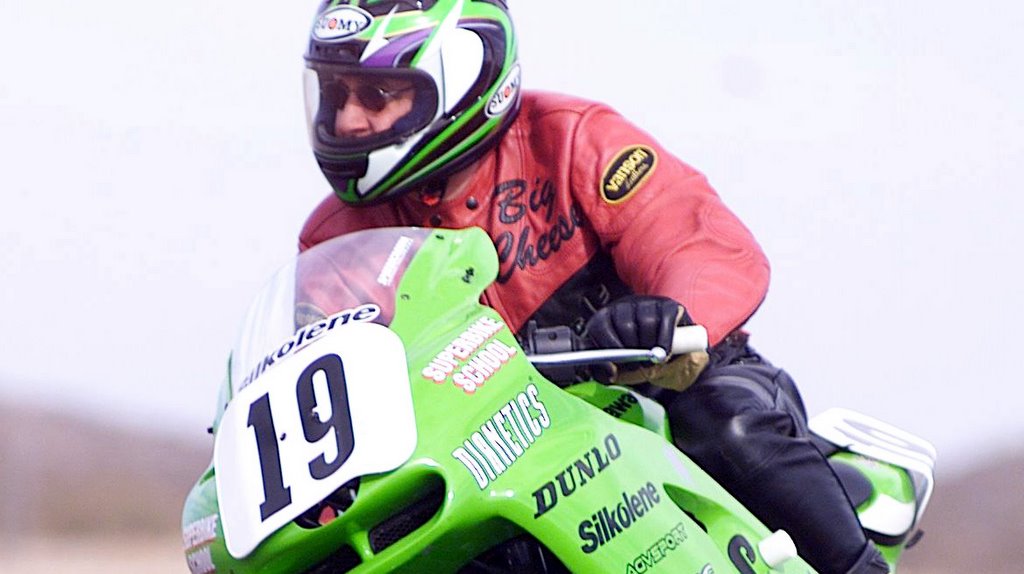
Many, many laps and couple of days later, I was in a rented Saturn with my friend Mike Salisbury, motoring to Streets of Willow Springs for a day at Keith Code Superbike School. My lap times fell from 3:45 to 2:11 in one day, thanks to Keith and his team, especially my instructor, Nancy "the Perfect Carrot" Montgomery, a strawberry blonde with piercing blue eyes. She would blow by me just close and fast enough to get my attention, then turn around and point to her tail, the universal signal for "follow me." As if there was ANY chance I wouldn't!

The setting sun signaled time for our good-byes. Mike navigated while I piloted the Saturn back to Venice Beach for a couple days touring the bike shops, surf shops and ethnic restaurants of Santa Monica. Ah, California, where life's a beach.

I had been in contact with the guys at Wild West Motorcycles, some two hours' ride away via freeway, and Mike had a Yamaha FJ1300. One Yamaha, two hours, and a handmade power cruiser sounded like an excellent recipe for mischief to me.

The Yamaha was fast, but I like my license and everywhere I looked were motorcycle-mounted police, mostly on BMWs and Harleys, but some local cops were riding Kawasakis. I gingerly toured toward Escondido.

The Wild West Motorcycle Company might as well be the "Hole In The Wall Gang Motorcycle Company." The factory, if you could call it that, is hidden in an industrial park, standing out only for its lack of signage. Wild West built about 100 bikes this year, each motorcycle made to order, like a Bentley. Engines balanced and blueprinted. Billet wheels measured for run-out and only the best accepted, combined with the most incredible fit and finish I've seen. All the work is done by hand. One man builds one bike.

I rode a Wild West Peacemaker as the sun sank in the west. Some guy in Atlanta had to wait an extra couple of days to take delivery so I could ride and photograph it, so I didn't ride it far. I felt bad for the guy.

I've got to thank the folks from Biker's Dream of Atlanta and offer kudos to Jason Orsborn, who built this Peacemaker. The next time I'm in Atlanta, I'll stop in and buy your customer lunch and a beer, but it'll cost you another ride.

Back on Mike's Yamaha and headed northwest, I took the longer ride to Venice Beach, where I had dinner in yet another restaurant of unknown ethnicity.

Flying home I started recording my impressions of the motorcycles and racetracks I'd experienced. It was time for the real work of motorcycle journalism.

When I reached the baggage claim in Newark my bag was the first one out of the chute and onto the carousel. I picked it up and suddenly I felt the urge to dye my hair blonde.

Sunday, September 15, 2002

Wild West Custom; Making Motorcycles the ol’ fashion way-one bike at a time!


Back when I had all my hair and a gallon of gas was two bits, muscle cars and Brit bikes were our chariots of choice. Motorcycles were one step below dependable (except for those nice people you met on a Honda) and though the cars were basically reliable, we worked real hard to make them run as badly as our bikes, then we worked at making the bikes run even worse. All in the name if individuality and the need for speed.

We took Brit bikes and Jap bikes (and some of us Harley’s) then tweaked, twisted, welded, raked, and stretched any part we could so that our sleds would look like the Billy Bike and take off like a banshee. Some shade tree techs got what they wanted, we all blew up lots of motors. And thanks to those years of distinct effort by demanding individuals, a new genre of American motorcycle came into its own; the Custom Cruiser.

Today you can buy a brand new bike and before you’ve taken delivery have all the hot whiz-bang-do-dads you like added on. Chrome, powder coating, custom paint and then there’s cams, carbs, and stroking. You can even get on a dyno and have a custom computer chip burned specifically for your bike’s setup.

Or you can just buy a Wild West custom, and have all you’ve dreamed about, lusted for and drooled over, straight from the crate, that I if you’ve got a spare 35 grand stashed under the mattress.

The location of the Wild West Motorcycle Company is anything but wild. They’re tucked away in a non-descript commercial building on a dead-end street in an industrial park in Poway California. Which was a two-hour freeway extravaganza from where I was staying in Venice Beach (and after making the trip I understood why no-one else wanted to go with me). Fleeting freeway flyers on cell phones and my New Yawk pedigree aside, I was well received by the Wild West folks in Poway, right about the time the sun started a dive toward the horizon. Andy Paluczak, Wild West’s Sales and Marketing Manager, gave me the nickel tour then pushed a Vigilante out of the plant’s freight entrance.

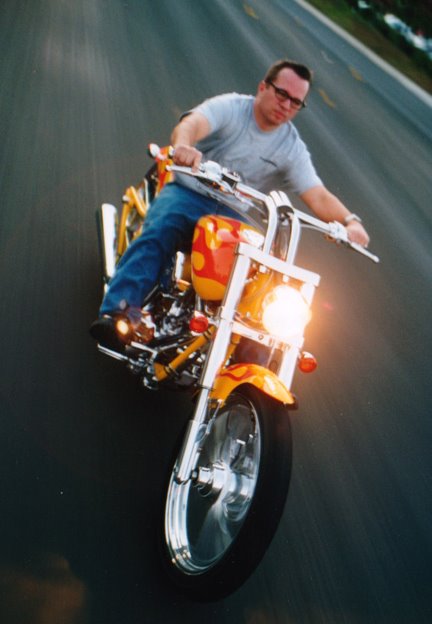
That was my first and only look at the bike in the daylight, which was fast becoming a scarce commodity. I could have stared and photographed it all day, the reflection of setting sun in exploded over the yellow tank with orange flames. The finish was impeccable, the welds smooth, and not a burnished fastener in the lot. But it was time to ride.

I confess; I’m not a cruiser rider. I’m partial to having my head tucked in behind a sport fairing and scouting for the fuzz, so every time I get on a bike that wants me to put my feet out in front of me and drag my bum along the pavement, it takes me a bit to get into the groove. That first time I let the clutch out I was waiting for the bike to tell me off, but it didn’t. I eased the lever out and the throbbing S&S twin and I rumbled out to the road.

Hands down, no argument, the Wild West Vigilante is the most solid motorcycle I’ve ever ridden. There isn’t any resonance, at any RPM. No buzz no boom, just seamless power. I’m sure the oil-in-the-frame protocol can be thanked for that. Coupled with the fact that Wild West doesn’t take the S&S engines out of the crate and bolt them to frames. Each motor is balanced and blueprinted, and Wild West’s tolerances are tougher than most, few parts make the grade. Ditto on the wheels, while they’re bought from another manufacturer but tested and only the best accepted. Stay tuned, they’ve recently installed a huge CNC machine and are testing designs for their own wheels.

Mounted on the Vigilante’s rear wheel is a 250 tire. Probably the only piece of over-the-counter rubber that could transmit the throbbing 105 horsepower to the pavement, other than a drag slick. I expected poor handling due to the rake and resplendent rump of a tire but was proven wrong. Again the proof is in the engineering, the Vigilante is perfectly balanced, take your hands off the bars (which took a ton of testosterone to try, the bike does cost 35 grand!) and the sucker tracks straight as a laser.

Wild West credits the Baker RSD (Right Side Drive) transmission for that. By switching the drive pulley to the right they’ve eliminated the need to offset the drive train. The result, perfect balance, and rolling along a mere 21 inches above the pavement balance become a noticeable issue.

It doesn’t surprise me that a small company of a dozen or so people with sales of about a hundred bikes a year would set a benchmark for quality construction and design. Distinctly American in concept and execution, the Vigilante lives up to its name, it takes no prisoners.


Motorcycle Courtesy of: Biker's Dream of Atlanta, 9560 Highway 9, Alpharetta, GA 30004
Owner: Don Parkinson
Phone: 770-752-9160
Fax: 770-752-9156
e-mail: donpbiker@aol.com
Web address: bikersdreamatl.com
Our bike builder: Jason Orsborn
Ideas for media kit-

Vigilante - Specifications

Frame: Steel tube cradle frame with integrated oil storage in 2" O.D. backbone and seat post tubes
Engine: S&S 107 ci – roller rocker arms, forged pistons, 600 cam, 9.6:1 compression ratio, 4.0 in bore x 4.25 in stroke, 105 hp, engine finish: polished
Carburetor: S&S Super G
Transmission: Right Side Drive - 5 speed, constant mesh, backcut gears, by Baker
Primary: Polished inner primary, chrome outer primary, double row chain drive
Clutch: Rivera Pro – 9 plate heavy duty wet clutch
Fenders: Rear - IST™ (Integrated Support Technology) strutless carbon fiber
Front - carbon fiber
Tank: 4.0 Gallon
Fuel Cap: Aircraft style, flush mount, polished aluminum
Forks: Inverted, 54mm, polished
Shock: Progressive with adjustable rebound damping
Wheels: Performance Machine forged aluminum, polished. Choice of Wrath, Trinity, Villain, Vintage, and Trespasser.
Brakes: Performance Machine 4 piston billet calipers, polished, 11.5” rotors
Tires: Avon – 250/40 x 18 rear and 90/90 x 21 front
Exhaust: Drag pipes with baffle, chrome
Rear Axle: 4140 chrom-moly
Seat: Leather, by Corbin
Belt: Gates HTD Polychain
Battery: Absorbed Glass Matt (AGM) – sealed, no maintenance
Handle bars: 1 1/4", internal wiring
Speedometer: VDO – electronic pickup, digital trip meter and odometer
Oil lines: Stainless steel braided lines with aircraft style fittings
Starter: Compufire – 1.5 kw, chrome
Grips: Arlen Ness - billet aluminum, chrome, with bearings
Forward Controls: Performance Machine – billet aluminum, polished
Paint: Tank/Fenders - level 4 custom paint,
Frame: matched powdercoat


Tuesday, June 18, 2002

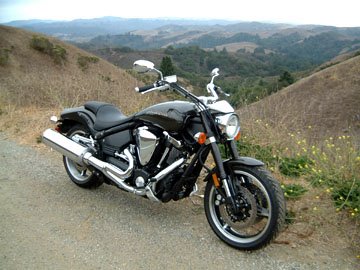
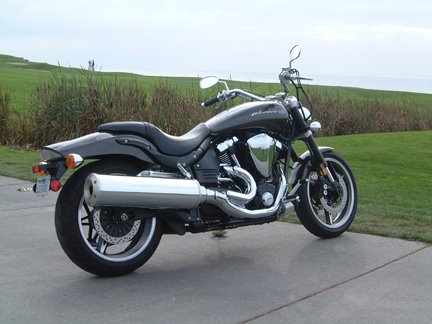
Yamaha Road Star Warrior – Power Cruiser for the Vertically Challenged -

June 2002-HALF MOON BAY, CA. Buying a motorcycle is an emotional purchase tempered with minor bursts of reasoning. But for an experienced rider who’s inseam sends them to the kids department for jeans, the emotional element completely loses out to reasoning. Despite suspension lowering kits and techs that will install them, usually with some sort of liability waiver or disclaimer, short riders keep riding and keep falling over at stoplights.

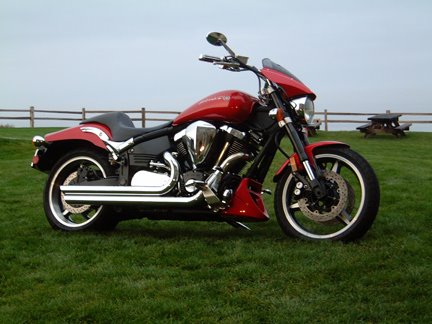
Enter the Yamaha Road Star Warrior with its 28-inch seat height. While taking the trophy at a limbo contest was not what the Warrior’s designers had in mind when they started the project it is certainly a major benefit to a large part of the motorcycle market and for those of you not vertically challenged the low seat has another benefit; you can really raise your ass off it, far enough that your head is above the smoke from the burnouts you’ll inevitably be doing.

One part muscle bike, one part streetfighter and one part cruiser the Warrior is the two-wheeled embodiment of the timeless icon that seduced so many before it: the classic, all-American Hot Rod.

It’s 102 cubic inches translates into a 1670 cc of air-cooled V-twin engine that produces 79.9 horsepower at 4,400 rpm and 103.8 lbs/ft of torque at 3,500 rpm. The air intake system is comprised of two intake boxes, their combined volume is a massive 7.5 liters. Offering a 115% increase in volume while lowering the intake resistance by 70% when compared to earlier Yamaha cruisers.

The engine has been bored from 95 to 97 mm increasing the displacement from 1602 to 1670 cubic centimeters (stroke remains the same at 113 mm). The cylinders feature a new high-volume, two-piece head (vs. the Road Star’s three-piece head).

An engine this massive has its worst drawback when it isn’t running and you want to start it. Ever watch a guy try to start an old Harley that’s been stroked? It takes a lot of power (leg or electric) to crank that sucker, so Yamaha added the same engine decompression system as on the Road Star. Simply put it releases the valve a bit during the start-up sequence. While this works just fine the bike makes some unfamiliar sounds when you press the starter, but you’ll get used to it, after all, it’s the sound power to come.

Fuel and air are mixed in the two 40 mm downdraft throttle bodies. The mixture then passes into the cylinders via a revised cylinder head design that offers a straighter intake path. Cooling fin area has been increased to keep the Warrior from getting hot under the collar.

The muffler weighs in at 8.3 kilograms. That’s 1.6 kilograms less than the standard Road Star muffler, while increasing internal capacity by 1.8 liters to 11.5 liters. The engineers also managed to keep the front and rear manifolds on the two-into-one system within and inch and a half, balancing the back pressure close to perfect. The exhaust looks large… it is but it sounds great, offering up a note that will please the most die-hard cruiser addict.

All this engine technology is managed by a seven sensor EFI system that tracks everything from barometric pressure to front and rear cylinder temperature, the most sophisticated EFI system on two wheels. An ECU works with a throttle position sensor to meter the fuel. Three-dimensional digital CD ignition mapping ensures that the spark ignites at just the right moment, delivering crisp throttle response. This system provides a power curve that rivals high performance sport bikes.

The engine is mounted in a newly designed and stiffer double-cradle design frame, 71% stiffer and 10.5 kilograms (Warrior frame weighs 17.5 kg) lighter than the standard Road Star frame. The engine is also rigidly mounted to stiffen the frame up even more.

Just as important to the handling as the new frame is the 41-mm, R1 inspired front forks, which are adjustable for preload. In the rear a preload adjustable mono-shock connects to an all aluminum cast, extruded and rectangular pipe swing-arm that also boasts an R-1 inspired pedigree.
Power is transferred to the super-fat 200-section rear via belt drive adopted from the original Road Star but shaved to 8.5 mm and 5-speed, wide-ratio, with multi-plate wet clutch transmission.

As the daylight began to wane the instrument cluster took on a light of its own. Traditional incandescents have been replaced by LEDs and that goes all the way to the taillight, which looks ineffective, until you grab the binders. A grand prix style digital bar graph tachometer sweeps across the rev range while the speedometer is nestled in a very retro looking brushed finished housing.

Looking for excellent stopping power Yamaha’s designers lifted a set of calipers from the R-1 and ditto for the diameter of the master cylinder. Sumitomo calipers bite into the two 298mm diameter front discs easily scrubbing off those few illegal mph’s you might, scratch that, WILL accumulate when you get lost in the Warrior’s personality. The single rear disc boasts similar specs. None of this will matter at all when the rubber meets the road.

While the Yamaha Warrior isn’t the first Japanese power cruiser that’s made it to our shores it has set a new standard for cruiser performance and handling.

Google Search