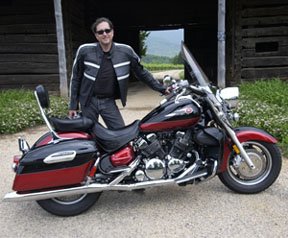
I just returned from ten days in California. Halfway into the trip, T Bear dropped me an e-mail that began, "Hey Caliboy, did ya die yer hair blonde yet?"
The location was Willow Springs International Raceway. A dozen or so of us slightly weathered journalists had gathered to enjoy the clean air and warm sun of California's high desert and to spend some track time with Ducati's Redvolutionary 999: the slipperiest, slickest and speediest Duc Bologna's ever sold.
I'll call it an early holiday gift from Ducati, only because when I call it work, people groan. Thanks Ducati!
Many, many laps and couple of days later, I was in a rented Saturn with my friend Mike Salisbury, motoring to Streets of Willow Springs for a day at Keith Code Superbike School. My lap times fell from 3:45 to 2:11 in one day, thanks to Keith and his team, especially my instructor, Nancy "the Perfect Carrot" Montgomery, a strawberry blonde with piercing blue eyes. She would blow by me just close and fast enough to get my attention, then turn around and point to her tail, the universal signal for "follow me." As if there was ANY chance I wouldn't!
The setting sun signaled time for our good-byes. Mike navigated while I piloted the Saturn back to Venice Beach for a couple days touring the bike shops, surf shops and ethnic restaurants of Santa Monica. Ah, California, where life's a beach.
I had been in contact with the guys at Wild West Motorcycles, some two hours' ride away via freeway, and Mike had a Yamaha FJ1300. One Yamaha, two hours, and a handmade power cruiser sounded like an excellent recipe for mischief to me.
The Yamaha was fast, but I like my license and everywhere I looked were motorcycle-mounted police, mostly on BMWs and Harleys, but some local cops were riding Kawasakis. I gingerly toured toward Escondido.
The Wild West Motorcycle Company might as well be the "Hole In The Wall Gang Motorcycle Company." The factory, if you could call it that, is hidden in an industrial park, standing out only for its lack of signage. Wild West built about 100 bikes this year, each motorcycle made to order, like a Bentley. Engines balanced and blueprinted. Billet wheels measured for run-out and only the best accepted, combined with the most incredible fit and finish I've seen. All the work is done by hand. One man builds one bike.
I rode a Wild West Peacemaker as the sun sank in the west. Some guy in Atlanta had to wait an extra couple of days to take delivery so I could ride and photograph it, so I didn't ride it far. I felt bad for the guy.
I've got to thank the folks from Biker's Dream of Atlanta and offer kudos to Jason Orsborn, who built this Peacemaker. The next time I'm in Atlanta, I'll stop in and buy your customer lunch and a beer, but it'll cost you another ride.
Back on Mike's Yamaha and headed northwest, I took the longer ride to Venice Beach, where I had dinner in yet another restaurant of unknown ethnicity.
Flying home I started recording my impressions of the motorcycles and racetracks I'd experienced. It was time for the real work of motorcycle journalism.
When I reached the baggage claim in Newark my bag was the first one out of the chute and onto the carousel. I picked it up and suddenly I felt the urge to dye my hair blonde.
Friday, December 01, 2000

Wednesday, November 01, 2000
Typos 'R Us

As publisher of this magazine, I’ve gone to press with my share of screw-ups. The first major one was five years ago when we issued telephone debit cards illustrated with a photo of Main Street in Daytona during Bike Week. The caption read: “Main Sreet.” At least 30 people had looked at the proofs and not one of us noticed the error. Sometimes you only see what you expect to see.
I’ve also made my share of grammatical errors, in my writing and in editing other writers’ work. All this despite owning a copy of Strunk and White’s Elements of Style, which happens to stand on my desk with Punctuation Made Simple, Webster’s Collegiate Dictionary, and the UPI Stylebook. I guess it would help if I occasionally opened one of them. But questions of grammar and style always seem to arrive at three o’clock in the morning when the boards are due at the printer by five. A time when my body is running at redline but my brain synapses are coughing at a lean idle. While in this condition I have to make decisions about correcting one, two, ten more little items (some or all of which might not be incorrect) or getting the magazine out. Publishing is not rocket science, CC Motorcycle News is not the Space Shuttle’s operating manual, and I don’t have five astronauts whose lives are in jeopardy, so the decision is easy: Damn the typos, full speed to the presses!
A couple of years ago I was invited down to New York University for an open house to inaugurate their new Masters in Publishing degree program. The panel of instructors asked everyone to introduce themselves and explain why they might be interested in taking the curriculum. I soon realized that I was the only actual publisher in attendance. When it was my turn to greet the assembled, I said, “I’d like to learn what I’m doing wrong because I have to work thirty-six hours straight prior to deadline.” A chorus constructed of all the people in the room rang out, “Why should you be any different?”
Needless to say, I never registered for the course.
What brings this discussion to this page is that I recently received a very formal letter from one of our writers. During a conversation, I had criticized the lead paragraph in one of his articles. He used the same noun in two consecutive sentences. Grammatically there is nothing wrong with that (I think). Style-wise, it bothered me. As far as I was concerned it was merely light commentary, but he took it very badly. It seems that I had made such a multitude of errors while editing his work that he felt it reflected badly on him. Additionally, I had made such grave errors in my own writing that he also felt I had no right to criticize him. He went as far as to return clippings of the stories corrected with very professional proof reading marks in red ink. Which I thought was really cool except that I didn’t know what those marks meant. (But I did figure some of them out.) What upset him the most was that I had misspelled some proper names. Two instances were in photo captions that I wrote. To one name I added a letter, in another I left one out. In a third case I printed the name wrong throughout an entire story, courtesy of the “Replace All” button on SpellCheck. As a result of my inadequacies, the writer felt that he needed to send letters of apology to the potentially offended individuals.
I admire him for his zeal. I wish all my writers were as adroit at protecting the quality of their work and cared equally about the quality of our publication. However, before I formally apologize to him, you folks, and any and all victims of my typos, I’d like to lay some facts on the workbench.
I am NOT nor have I ever been an English major. I have never, or at least to my memory, formally studied grammar or English usage. I go by the rule that if it sounds good and runs smooth, it is good. (Which is also why I’ve hired copy editors.) If it wasn’t for wood shop and auto mechanics I might have never made it out of high school. But I did, then I had five more years of education, during which I never took an English course. Before I bought this magazine I worked as a photographer—commercial, advertising, and fashion. Not a lot of spelling or syntax errors to make in that business. Yet during all those years I had written stories for many publications, all of whom had editors to correct my deficiencies.
I never claimed to be the Caped Crusader of Copywriters and I conceive no calamity in an accidental inaccuracy. So riddle me this, my antagonists: Who rides a motorcycle, was raised by two English teachers, and just returned from a honeymoon of motorcycling in Greece? The Answer: Edward Batchelder, our current copy editor. Since Edward the Accurate was on vacation when I wrote my column for last month’s edition, it was peppered with typos, non-sequiturs and run-on sentences. Sorry, kids.
As a publisher, editor and journalist, I take solace in knowing that among the erroneous I am in good company. History has provided us with some great journalistic gaffs. The most famous of these occurred in 1948, when the Chicago Herald Tribune declared Thomas Dewey the newly elected President of the U.S. This wasn’t correct; Harry Truman won the race. The editor, convinced by early polls declaring Dewey the winner of the Presidential election, ran the story. Then he decided to get to bed early, only to wake up the next morning to find himself, the early polls, and his seventy-two point headline wrong. The moral here is that when you screw up big time, you can earn a place in history. CC Moto News and our offended writer will be remembered by those folks whose name I misspelled long after all the other magazines are recycled into blank paper. And we will be forgiven for our digressions.
In conversations with other publishers, I’ve learned that I am not alone. We all agree that no matter how many times a publication is edited and proofread, somewhere between the office and the printing press a little gremlin creeps into the work and changes something around.
So if a typographical terror that appeared in this organ has ever offended anyone, be you readers, writers or relatives of people we’ve published stories about, I AM SORRY. I suffer serious brain farts at 3 a.m. and I am undereducated in the technical aspects of the English language. Rest assured that corrective measures are being taken.
Truthfully though, no-one has ever been maimed by motoring under a dangling participle.
Friday, September 15, 2000
Winning Awards!
Excuse me a moment, I’ve just a couple of more connections to make. Could you hand me that screw driver, yeah, the one with the green handle. OK, the relay is secure, now I’ve got to reconnect the ground strap. Where’s that 10mm wrench? Ah, done at last.
Step back a bit, this could be loud. “BLAAM!”.
Oh that sounds good, nothing like an air horn. Watch out, I’ve got to hit this button a couple of more times.
“BLAAAM,” Think I woke the neighbors yet?
“BLAAAAAAAAAAAAAAAAAAAAAAAAAAAAAAAAAAAM!!!!!!!!!!!!!”
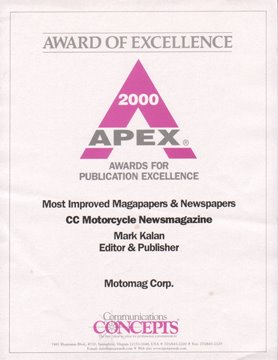
Hey, sometimes you’ve got to toot your own horn, after all, who else is gonna do it for you? And I’ve got what to toot about. I earned two major awards this month.
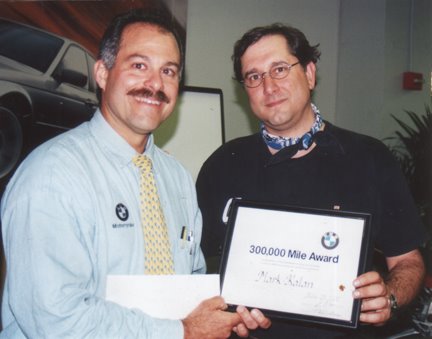
The first is the 2000 APEX Award for Publication Excellence (thumb through this magazine and read that sentence again) and the second is a BMW Motorcycles 300,000 Mile Award. Neither award is on par with a Pulitzer prize, which arrives with a six figure check or an Oscar for which I could dig my Tux out of mothballs, buy my wife a slinky satin dress then parade for an international television audience. So instead I mounted an air horn on my bike.
One more time, “BLAAAAAAAAAAAAAAAAAAAAAAAAM!!!!!!!!”
As with all journeys, there is a story behind them. Comparatively, the BMW Award was much longer in coming than the Apex award. Well, maybe not. I started learning printing in seventh grade at the Orangetown Junior High School. I learned how to set type by pulling each letter out of a California type case and placing it in a composing stick. I printed assorted business cards and invitations on a pilot press. By the time I got to High School, photo offset had taken hold and I was printing the school paper, along with being the photography editor. I still have samples of all that old work. during my Senior year in High School I got a job on the local newspaper. I’ve often said that if it wasn’t for wood shop and graphic arts I would have never graduated High School. I studied photography in college then returned to New York City to work in the advertising business. Eventually I opened my own studio in downtown Manhattan and worked as a fashion photographer.
There is a fabulous, little known fact about the fashion business in New York City; from Memorial Day to Labor Day no-one works on Fridays or Mondays. They all have country/weekend/vacation houses that they must go to. So not only can’t you book a model but there are no photographers, make-up artists or hair dressers either. It was the perfect field for someone who wanted to spend weekends traveling by motorcycle. At the coffee maker on Tuesday morning everyone would be talking about so-an-so’s party at the beach and I would tell tall tales of two wheeled travel. I’ve often thought that my career in the fashion business might have reached greater heights had I attended those Hampton beach parties, but truthfully I was happier being in the middle of bum*#@^ nowhere, sweating in my leathers while gassing up my motorcycle at the only filling station within a two hour ride.
The BMW Award started with my first serious motorcycle. I bought an ‘83 BMW R 80 ST. I didn’t start out to be a Beemerphile. I was shopping for a motorcycle to travel long distances and happened to like the R80 when I saw it. It’s inaugural voyage was to the first Rocket City Rally in Huntsville Alabama. Nine hundred and sixteen miles. Cockily, I figured I could do it in eighteen hours straight. I loaded my camping gear, kissed my wife good-bye and hit the road. Four hours later I crossed the Delaware Memorial bridge, my butt was so sore I pulled into the Howard Johnson’s Motor Lodge and got a room. (Mikes Famous Harley-Davidson is now on that very spot.)
I finally made it to Alabama around noon Sunday. I rode into an empty campground. There were a couple of members of the Alabama Beemer Club still cleaning up.
“Hey guys,” I called as I took off my helmet. “I just got in from Brooklyn, where’s the rally?”
Well, I missed the Rally, but those who where there took me on an incredible ride that encompassed all the Poker Runs and Tours that they had during the Rally, after which they argued over who would buy me dinner and who’s lawn I could camp out on. That weekend trip turned into ten days and I made friends that I’ve kept in touch with all these years.
After 140,000 miles, 10 rear tires and 14 front tires the R 80 ST became a K 75 S. I wanted a bike with more current technology and more power to carry my ever increasing collection of camping equipment. Then in 1985 I bought a K 1100RS. On September 20th of this year the K 1100 RS will be mine after 60 payments. (At 1.9% APR!!! If you want a BMW, you’ve got to check out BMW’s financing deals!)
Both the motorcycle and the magazine have launched me on more journeys that I have the ink to print. I’ve ridden across the Mojave Desert and the Alpine mountain range. I’ve been lost in the back woods of North Carolina. I rode moto-escort for a photographer as he shot pictures of Lance Armstrong crossing the finish line at the Core States Classic bicycle race in Philadelphia. And I’ve stayed awake for days finishing this publication so all of you could read about it.
So...
“I’d like to thank the Academy and the Board for these Awards, a special thanks to my wife who stood by me all these years and my parents and professors....”
Aw, screw it!
“BLAAAAAAAAAAAAAAAAAAAAAAAAAAAAAAAAAAAAAAAAAAAAAAAAM!”
Tuesday, February 01, 2000
1984 ALL OVER AGAIN
Two-hundred-and-twenty-seven years ago, on December 16, a group of plucky American businessmen were tired of having the British Monarchy erode their profits with taxes. They conspired a protest, then raided a ship in the Boston harbor, dumping its cargo of tea. On July 14, 1789, thousands of French peasants raided the notorious Bastille prison, heralding the French Revolution and replacing the monarchy with a democracy that espoused “Liberty, Equality & Fraternity.” Fifty years ago, a group of refugee Jewish settlers living on the coast of Palestine organized a war to provide self-determination for a Jewish people. Freedom and Democracy has never come easy.
In his novel 1984, George Orwell warned us about a society where everything a citizen does and thinks would be controlled by the government. Back in the year 1984, many parallels were drawn between reality and Mr. Orwell’s fantasy. The general consensus was that we had avoided such a calamity. But have we?
Now that the year 1984 is old enough to drive into the next millennium, perhaps we should take another look. The Orwellian government controlled the populace with torture and repression. We don’t do that here, or do we?
How about the movement we’ve seen in the last decade of political correctness in media. Negro people have become African-American, homosexuals are now Gay, and don’t you dare call a woman a girl! Recently we’ve learned the White House has encouraged the television networks to place anti-drug themes in their productions in exchange for lowering the amount of time required for public service announcements. These things are not exactly torture (unless you’re watching television) but they are certainly a form of repression.
We’ve all seen the signs SPEED CONTROLLED BY RADAR. Think about it—the radar doesn’t control your speed, it only threatens your wallet, your economic viability. If the cop tags you with his radar/laser gun, then you’re going to shell out your hard-earned greenbacks to the government and the insurance company.
Speaking of insurance companies, Progressive Insurance is testing a new idea in Texas. With the car owner’s permission (those stupid suckers!), Progressive installs a black box under the driver’s seat. The box records the amount of time and distance that the car is driven. At least, that is all they say that they’re recording. The theory is that the less time and distance that the car is driven, the less risk that vehicle is in, so the lower the insurance premiums. There’s that wallet factor again.
Progressive isn’t the latest organization to test Orwellian controls on the population. At Leeds University in Britain, they’re testing an “intelligent speed adapter.” This unit will keep track of the vehicle’s location using Global Positioning System satellite signals. Then it will measure the vehicle’s speed and compare it to a database of speed limits. If the operator exceeds the speed limit, the black box will throttle back the fuel supply. Just the thing you need while passing a tandem tractor-trailer on a secondary road at night.
Had enough, kids? Sorry, it ain’t over yet! Over the last few years in Britain they’ve had “Gatso” cameras installed along popular motorcycling roads. These are self-contained camera-radar units that photograph the “violator” with nary a police-person in sight. The unsuspecting motorcyclist arrives home from his Sunday sojourn to find a pair of Bobbies with a set of handcuffs waiting at his front door. On the positive side (if you could possibly see it that way), a British insurance company has risen to the challenge by offering “Loss-of-License” protection. Edgar Hamilton, Ltd., will pay up to 14,400 pounds sterling for your choice of alternate transportation should you get “knicked.” As Fast Bike magazine reports, “. . . [while] they would not wish to condone irresponsible riding, they do recognize that with the prevalence of gatso cameras even Malcom Mild could lose his license in one high-spirited trip to the supermarket.” The insurance is sponsored by MAG (Motorcyclists Against Government) and costs £3.50 per month.
Governments and insurance companies are not the only organizations riding the 1984 bus. Mel Farr Motors of Detroit, MI will sell almost anyone a car, regardless of their creditworthiness. Mel controls the cars with a remote ignition-cut-off device. You don’t make your payment on time and the car won’t run, or if it’s running it will stop. Even if the driver is on his way to Mr. Farr to make a payment. Many industry experts have reported that the devices are dangerous and could even be a fire hazard. Detroit attorneys Lawrence Charfoos and Ken Hylton filed a lawsuit against the used-car dealer, but report little sympathy from the court.
From the Payback-is-a-bitch—Department of Misused-Technology, two Brit highway cops were sitting in wait for motorists on the A1 when their hand-held laser gun measured a speed in excess of 300 mph. The gun then seized and the cops could not reset it. It seems that they had locked onto a NATO Tornado fighter aircraft on a low-level flying exercise. The laser had activated the aircraft’s on-board tactical computer which instantly jammed the machine and armed a Sidewinder missile. Luckily (again, depending on your point of view), the pilot was able to disarm the missile before it vaporized the cops and everything within one square kilometer around them.
Now that’s the kind of laser/radar detector I'd like to have.
In his novel 1984, George Orwell warned us about a society where everything a citizen does and thinks would be controlled by the government. Back in the year 1984, many parallels were drawn between reality and Mr. Orwell’s fantasy. The general consensus was that we had avoided such a calamity. But have we?
Now that the year 1984 is old enough to drive into the next millennium, perhaps we should take another look. The Orwellian government controlled the populace with torture and repression. We don’t do that here, or do we?
How about the movement we’ve seen in the last decade of political correctness in media. Negro people have become African-American, homosexuals are now Gay, and don’t you dare call a woman a girl! Recently we’ve learned the White House has encouraged the television networks to place anti-drug themes in their productions in exchange for lowering the amount of time required for public service announcements. These things are not exactly torture (unless you’re watching television) but they are certainly a form of repression.
We’ve all seen the signs SPEED CONTROLLED BY RADAR. Think about it—the radar doesn’t control your speed, it only threatens your wallet, your economic viability. If the cop tags you with his radar/laser gun, then you’re going to shell out your hard-earned greenbacks to the government and the insurance company.
Speaking of insurance companies, Progressive Insurance is testing a new idea in Texas. With the car owner’s permission (those stupid suckers!), Progressive installs a black box under the driver’s seat. The box records the amount of time and distance that the car is driven. At least, that is all they say that they’re recording. The theory is that the less time and distance that the car is driven, the less risk that vehicle is in, so the lower the insurance premiums. There’s that wallet factor again.
Progressive isn’t the latest organization to test Orwellian controls on the population. At Leeds University in Britain, they’re testing an “intelligent speed adapter.” This unit will keep track of the vehicle’s location using Global Positioning System satellite signals. Then it will measure the vehicle’s speed and compare it to a database of speed limits. If the operator exceeds the speed limit, the black box will throttle back the fuel supply. Just the thing you need while passing a tandem tractor-trailer on a secondary road at night.
Had enough, kids? Sorry, it ain’t over yet! Over the last few years in Britain they’ve had “Gatso” cameras installed along popular motorcycling roads. These are self-contained camera-radar units that photograph the “violator” with nary a police-person in sight. The unsuspecting motorcyclist arrives home from his Sunday sojourn to find a pair of Bobbies with a set of handcuffs waiting at his front door. On the positive side (if you could possibly see it that way), a British insurance company has risen to the challenge by offering “Loss-of-License” protection. Edgar Hamilton, Ltd., will pay up to 14,400 pounds sterling for your choice of alternate transportation should you get “knicked.” As Fast Bike magazine reports, “. . . [while] they would not wish to condone irresponsible riding, they do recognize that with the prevalence of gatso cameras even Malcom Mild could lose his license in one high-spirited trip to the supermarket.” The insurance is sponsored by MAG (Motorcyclists Against Government) and costs £3.50 per month.
Governments and insurance companies are not the only organizations riding the 1984 bus. Mel Farr Motors of Detroit, MI will sell almost anyone a car, regardless of their creditworthiness. Mel controls the cars with a remote ignition-cut-off device. You don’t make your payment on time and the car won’t run, or if it’s running it will stop. Even if the driver is on his way to Mr. Farr to make a payment. Many industry experts have reported that the devices are dangerous and could even be a fire hazard. Detroit attorneys Lawrence Charfoos and Ken Hylton filed a lawsuit against the used-car dealer, but report little sympathy from the court.
From the Payback-is-a-bitch—Department of Misused-Technology, two Brit highway cops were sitting in wait for motorists on the A1 when their hand-held laser gun measured a speed in excess of 300 mph. The gun then seized and the cops could not reset it. It seems that they had locked onto a NATO Tornado fighter aircraft on a low-level flying exercise. The laser had activated the aircraft’s on-board tactical computer which instantly jammed the machine and armed a Sidewinder missile. Luckily (again, depending on your point of view), the pilot was able to disarm the missile before it vaporized the cops and everything within one square kilometer around them.
Now that’s the kind of laser/radar detector I'd like to have.
Thursday, July 01, 1999
Talking My Way Out of a Ticket on the New BMW K1200LT
In 1973, President Richard Nixon was faced with an energy dilemma. The Arab cartels were putting the squeeze on the oil companies and a gasoline shortage ensued. People were waiting on line to buy fuel and a panic was rising among the populace.
Many controls were tried in order to conserve energy. Rationing was invoked. One day only cars with even plates could get gas, the next day cars with odd number plates. Another solution was to impose a national fifty-five mile per hour speed limit. Many states already had a fifty-five limit, but under threat of federal highway funds being withheld all of the other states fell in line, except Montana, they never had a speed limit and weren’t going to be forced to have one by the Feds.
Many controls were tried in order to conserve energy. Rationing was invoked. One day only cars with even plates could get gas, the next day cars with odd number plates. Another solution was to impose a national fifty-five mile per hour speed limit. Many states already had a fifty-five limit, but under threat of federal highway funds being withheld all of the other states fell in line, except Montana, they never had a speed limit and weren’t going to be forced to have one by the Feds.
At face value the national speed limit wasn’t a bad idea. It does save gas to drive slower and it reduces pollution. The powers that be also told us that it reduced traffic fatalities. We were propagandized with the phrase, “Speed Kills.” If your speaking about illegal drug use, you would be correct, but as far as highway use it was a lie. The new limit also had some other side affects that were beneficial to the government and industry.
During the duration of the fifty-five limit many grass roots organizations fought the speed limit. It was breeding disrespect for government, highway police and insurance companies because no-one obeyed it anyway.
During the duration of the fifty-five limit many grass roots organizations fought the speed limit. It was breeding disrespect for government, highway police and insurance companies because no-one obeyed it anyway.
But it was a money maker to all those powers. Money flowed from our pockets into the coffers of mega corporations and minor governments at an alarming rate. Local judges presiding in small municipalities that reside along highways were bringing money into their towns reaping the financial windfall from the increasing number of speeding tickets. Insurance companies raised the rates that they charged to drivers convicted of speeding and the Feds were just plain enjoying having the power over the states, they were able control one more aspect of our lives.
As the gas shortage became a small footnote on the pages of Nixon’s career, our own federal Department Of Transportation began a serious study on the effect of the fifty-five limit. The study showed a negligible reduction of traffic fatalities. Many accident reports placed “excessive speed” as part of the cause, but despite a continuing government conspiracy the report proved that speed alone didn’t kill. That DOT report was published during Ronald Reagan’s reign, and summarily squashed. But during the Bush presidency it was leaked to the people fighting the speed limit. Now we had evidence created by the very powers that they were fighting against.
It took more than thirty years to prove it but the facts show that the lower speed limit doesn’t affect the traffic fatality rate at all. Most fatal accidents happen at or below the fifty-five miles per hour line. And I haven’t even mentioned the quality of the vehicles that we drive compared to three decades past.
We are now enjoying a sixty-five mile an hour speed limit on most of our highways. But did you noticed that when the sixty-five miles per hour speed limit signs were erected there was a new twist. The phrase, “fines doubled” was added.
The repeal of the fifty-five mile per hour limit happened to the chagrin of the insurance companies and municipalities that I mentioned before. They cried that there would be carnage on the roads, more people would die, but the truth is that they saw their financial free ride flying out their power windows. They were spending more money on high tech cop cars with computers, Vascar, Radar and Laser speed detectors. They have to pay for these toys. Enter the reality of political compromise; raise the limit but double the fines.
When New Jersey put the new higher limit signs up, Governor Christy Whitman said that it was only a test, and if the accident rate went up then the limit would go back down. Meanwhile her own chief of the state troopers was quoted in a newspaper as saying he himself had to exceed the stated speed limit on the Garden State Parkway because if he didn’t someone would drive up his...uh, trunk. The chief was forced to recant. Meanwhile the accident rate dropped, and the new limit will remain.
That’s it for the history lesson, here’s the story; last week I picked up BMW’s new K1200LT for an evaluation. It’s a motorcycle that is made in a country whose highways have no speed limit at all. It’s also a triumph of millennium technology. The bike has anti-lock brakes, electrically controlled windshield height, heated seats and grips, a heated backrest for the passenger, electronic cruise control, and a six CD stereo changer.
I took possesion of the bike at Bob’s BMW in Maryland with plans to ride it all the way to our offices in Nyack, just north of New York City. The weather was a bit on the hot side for full leathers, but I always dress for the ride. I left Bob’s about 11 am for a full days touring. I rode the secondary two laners through the picturesque farmland of Maryland, took the Bay Bridge over the Chesapeake then boarded the ferry, two hours later I was in Cape May, New Jersey.
I treated myself to a broiled fish dinner on Beach Street then began the one hundred and ninety mile trip home. Travel plans included the Garden State Parkway for its entire length, the very same parkway that had chief of the New Jersey State Troopers breaking the speed limit. Then I’d take the New York State Thruway east for a few miles. It was six o’clock when I left Cape May.
I treated myself to a broiled fish dinner on Beach Street then began the one hundred and ninety mile trip home. Travel plans included the Garden State Parkway for its entire length, the very same parkway that had chief of the New Jersey State Troopers breaking the speed limit. Then I’d take the New York State Thruway east for a few miles. It was six o’clock when I left Cape May.
The ride up the Parkway was the best that I’d ever had. The temperature was dropping slowly, the thermometer from the onboard computer read 78° and the sun was making its journey toward the horizon at a snail’s pace. I realized that it was the summer solstice, and I’d spent most of the daylight hours on the longest day of the year riding a bike. To say the least. I was very happy.
I kept the motorcycle in the left lane, cruise control set at eighty miles-per-hour. The windshield was cranked all the way up and so was the stereo. I kept checking my mirrors, I passed cars steadily but still had to move over many times for someone to pass me. And I didn’t see a police car the entire ride. At nine PM, when the last rays of daylight faded from the sky I pulled into the Montvale service area, the final gas stop on the Parkway. I topped off the tank then began the last few miles home.
I felt no fatigue at all, the K1200 performed flawlessly and was as comfortable as my favorite chair. Two more exits to go, a mere three miles, and I looked over my left should to see if the lane was clear then passed a group of cars that were doing their bumper to bumper NASCAR impression at seventy miles an hour. The speed limit in that area is only fifty-five. I put on my right signal, looked over other shoulder and moved into the right lane. That’s when I heard the siren and saw the red whoopee lights.
In no time I was stopped on the shoulder. I took off my helmet and waited for the cop. He was a little guy with a big flashlight. I didn’t give him a chance to speak, I looked at him and said, “Man, I’m sorry I made you put on your lights and chase me down.” I held up my thumb and forefinger, “look I’m this far from home, I’ve been on this bike all day, I started in Baltimore, I’m just this far (fingers again) from home,” I pleaded.
“License and registration.”
“Well here’s my license, but I don’t have a registration, this is a manufacturer’s bike that I’m test riding, I do this for a living. Hey I’ve got all these PBA cards,” I fanned out the handful of plastic cards that my police friends had given me.
“They aren’t gonna help you this time.” he was getting stern. I knew that I must have been doing about eighty-five when he spotted me.
“Come, on, I do this for a living, I’ve got a clean license.” Just then two kids on crotch rockets with loud aftermarket pipes blew by. They were wearing full face helmets with t-shirts and shorts. One turned his head and looked at us.
The cop noticed the kid then pointed his flashlight at my boots and ran the beam up my leather pants and jacket. “Well, at least your dressed for it.”
“Like I said,” I repeated, “I do this for a living, I publish a motorcycle magazine.”
“I’m gonna check your license,” was all he said, then he walked back to his cruiser. As I sat there I envisioned him in the cruiser’s air-conditioned cocoon, surrounded with all the latest cop techno-gadgetry, punching the number of my license into his computer terminal. I imagined the electrons bouncing back and forth to some antenna then to Albany, then to some criminal database. I knew that the info would come back clean. But thousands of years from now, that signal would reach a planet in some distant galaxy and some alien scientist will know that I was pulled over by a cop during Earth’s summer solstice.
The Trooper walked back to me and the bike, then returned my license. “It’s your lucky day,” he said, “but I want you to drop off a copy of your magazine at the barracks so I know that you’re telling the truth.” I opened the saddlebag and gave him a copy, on the spot.
He didn’t give me a ticket because I was licensed, properly equiped and pleasant, plus he knew that the limit only exists to raise money. If we trained our drivers better we wouldn’t need to argue this and we could send our troopers out to chase down violent criminals. But money talks in our society and the car and insurance companies would rather sell more products to make more money, and there is no money in arrestng a deadbeat dad or finding a fugitive. If it was more difficult to get a drivers license or you couldn’t buy a vehicle without proper training our roads would be a lot safer, regardless of the legal speed limits.
As I drove off, thrilled with having one of the most perfect rides of my professional moto-journalism career, and with talking my way out of a “NYS Excellent Driver Citation,” I realized something. The edition of CC Motorcycle Newsmagazine that I gave him carried the story about my ride from Minneapolis to Duluth on a Ducati 900ss. One hundred and seventy miles in the rain, travel time; an hour and a half.
I hope he doesn’t read it, because if he does and I ever run into him again, I’m screwed. But hey, it’s my job.
Subscribe to:
Posts (Atom)